How to Automate and Syndicate your Posts

What we are going to cover…

1) How to write content that is relevant to your target market and shareable.

2) How to automate and syndicate a blog posts, while at the same time generating traffic to the website?

3) How to automate and syndicate social networking postings, saving you tons of time

4) What kinds of Social Networking posts generate social engagement?

5) Ideas to get your visitors to share your content and join you at social networking sites.

If you write ‘killer content’ that is relevant, moving, and maybe even funny, your visitors are more likely to share it with their audience… it could even go viral.

Here are 5 tips that will help you create content with viral potential:

1. Start with a catchy, intriguing and well crafted article title

A strong title can mean the difference between hundreds of visitors — or none. And, the more visitors, the more chances you have that those visitors will share your brilliant content.

At WordPress.com alone, there are on average 1.4 million posts published every single day. That is not counting the endless stream of new content created around the internet.

The first thing most people will see is your title, so make it a good one.

You can find more tips on how to craft a page title that will be authoritative, fascinating, and exceptional at Internet Marketing Tips; the Page Title is the First Impression

2. Makesurereaderscanreadyourpost!

I know you are wondering what that means… “Make sure readers can read your post!”

If your content looks like it was crammed into a space, not only will it be hard to read, it will likely drive your visitors to leaving your page. There are many factors that affect readability; font color, size, paragraph length, background color, etc.

If it is hard to read, it’s not going to get read – or shared.

It helps to keep your sentences short and snappy. And, your paragraphs short with no more that 3 – 4 lines. Lots of white space makes long posts easier for readers to read. Headings, sub-headings,  and block quotes create space making a long post easier to scan. Bullets and numbered lists are easier to digest, very shareable and provide simple, clear visitor takeaways.

3. Add an image to your article

Your image should in some way be relevant to your website, it could be a photo, logo, graph, infographic or cartoon. If your image tells your visitor what the article is about, there is a better chance that your content will not only get read, but also shared.

Keep in mind that your image acts as a mini-billboard that people will notice. And on social networking, posts with images get more clicks then those without which means that people are more likely to notice and share.

Another advantage of images is they help create more white space, making written content easier to scan by the visitor.

4. Be a resource for others.

People like to share things that make them laugh, inspire them, or in some way add value to their friends, followers, connections AND (most important) their target market.

Even if you don’t think you are inspirational or funny, you all have something to share that will add value to other peoples lives;

  • If you are an expert – teach us!

  • Do you have access to some great resources in your field – share the links!

  • Have you discovered a new angle to solve a problem – share it with us!

Sharing your knowledge establishes your expertise and makes you a resource for your audience – providing them with tips and tools that they will share with their friends, followers and connections.

5. Share your web articles, videos, infographics, etc.

Drive traffic to your website at your social networking sites, and once it is out there you have made it easier for people to not only click through to your website, but also share your posts with just a click.

How to share your fresh content easily just as soon as it is published.

I know that you have all seen Share and Join Me icons, and maybe you have even figured out how to add them to your website.

But for those of you that don’t know how… try these ideas:

At wordpress.com:

For a double whammy, you can add both Share This buttons and Join Me at icons at your wordpress.com website. Just go to the dashboard, click on Settings (lower left-hand side) and then in the drop-down click on Sharing.

In this section of wordpress.com you can add 6 Publicize buttons, a.k.a as Join Me icons. When you are done publishing your web article, you can click on these Publicize buttons and immediately share your fresh content to your social networking sites.

And, then there are the Share icons (usually down below your new content) which make it easy for your visitors to Share your ‘killer content’ at their social networking sites.

At wordpress.org:

When using this format you have to add plugins. My favorite plugins are: Shareaholic for Share icons and Plus One Button, WP Tweet Button and Auto Pin It Button which you can use to publicize your fresh content, and they are also available to your visitors.

NOTE: I get a lot of G+’s that way.

Remember, share your own ‘killer content’ just 10% – 20% of the time, more than that and you are going to turn-off your friends, followers and connections. At the social networks you do not want to get the reputation for ONLY blowing your own horn and not sharing other stuff.

Types of Content you can share the other 90% of the time

1. Quotations, simply go to brainyquote.com or quotegarden.com choose quotes by Topic or Author.

2. Questions, you know the kind you ask everyday…Who is your favorite celebrity? What is your favorite holiday? If you could vacation anywhere in the world, money is no object, where would that be? …and so on.

3. Promote other content you find around the web that you think your friends, followers and connections may be interested in. (Google Alerts).

4. Share pictures… nothing embarrassing, like a picture of your cat. Or, a picture of the function you are attending… a Chamber Meeting, a baseball game, an office meeting, etc.

5. Share videos – videos you created, or videos you found on YouTube.

HOMEWORK

4:1. Add Share icons and Publicize icons (aka Join Me buttons) to your website.

4:2. Use those icons to publicize your fresh ‘killer content’.

4:3. Everytime you share your fresh content, share at least 5 more relevant posts that do not send people to your website

Automation & Syndication

Marketing Automation is the name given to software platforms designed for marketing departments and organizations to automate repetitive social networking tasks.

These days, it is relatively easy to drive traffic to your website and share content at your social networking sites. Of course it doesn’t hurt to optimize it for the search engines so that it can be found easily. IF, and this is a big IF, your friends, followers and connections SHARE your content, is more likely to get inbound links.

Web syndication is a form of syndication in which website material is made available to multiple other sites. This means you can send out your message to several of your social networking sites all at one time.

I know you may are probably already aware of these type of products, and you may have even used them. I’ve used several, and every time I come back to my favorite – hootsuite.com

Automate with Hootsuite

The free version of hootsuite allows you to add 5 social networking sites including; Twitter, Facebook, LinkedIn, WordPress, WordPress, Foresquare, and Mixi.

Type hootsuite.com in the the browser bar. Click the Sign Up now, choose the Free version and then fill in the blanks and submit.
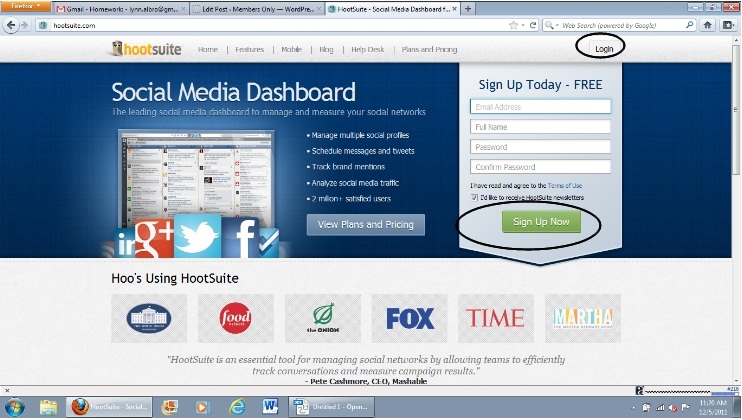
Now, sign in and click on Secure Login
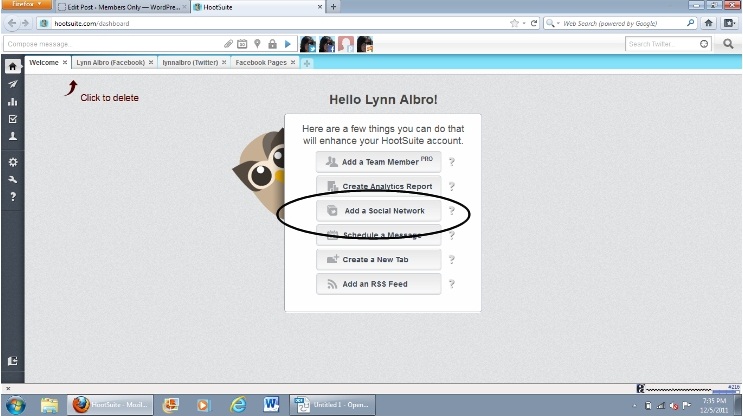
In the next screen, click on Add a Social Network. In the pop-up window click on +Add Social Network and then add your Facebook Profile and Business Page, LinkedIn Profile, Twitter site, and Google+ Business Page.

How to add and schedule posts at Hootsuite.

Copy the text of the content you want to share, then paste that into the Compose Message box. Click on the icons that you want this message sent out to, then click on the middle icon that says 30 (this is your calendar). Set the day and time you want your message to go out…then click on Schedule.
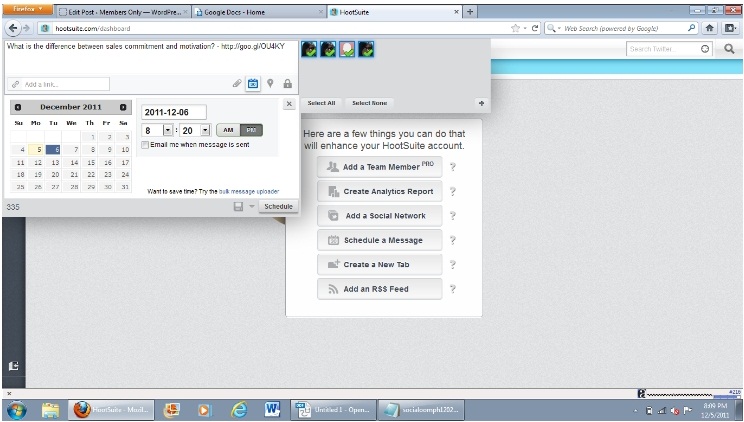
When you click on the social networking tab, at the top of the dashboard, and note that all the way over to the right you will find your Pending Posts that are scheduled.

Also in that same screen you can interact with some of your social networking sites. All you have to do is click on Add a stream. Choose which of the social networks that you want to add a stream on the left hand side, select a profile in the middle section, then choose the appropriate streams.

  • For Twitter I suggest: Scheduled Tweets, Direct Message, Mentions and My Tweets, Retweeted.

  • For Facebook I suggest: Scheduled Stream Posts, News Feed-Most Recent, and Wall Posts.

  • For Facebook Business Page I suggest: Scheduled Messages, Private Messages, Wall Posts and Private Messages

  • For Google+ Pages I suggest: Scheduled Messages, Home Stream, and Sent Messages

  • For LinkedIn Profile I suggest: Scheduled Updates, My Updates, All Updates.
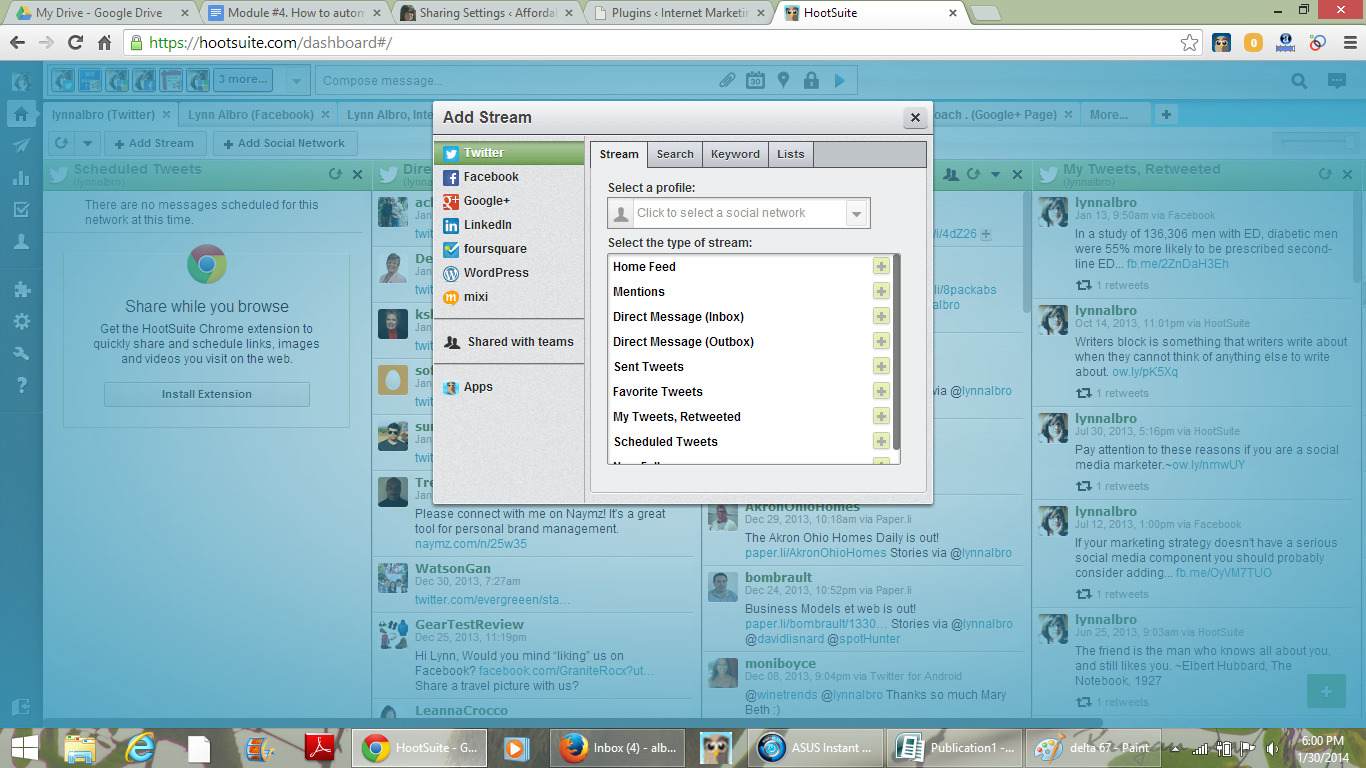
Once you have set these streams up, you can use the Hootsuite dashboard to monitor what is going on in all of your social networking channels.

For instance, click on the Twitter tab…you can see and respond to Twitter posts, Mentions and Direct Messages. In the Facebook section you can ‘comment, like & share’ posts written by your friends.

Keep a record of your posts, and down the road you can use them again.

NOTE: You spend a lot of time making sure that you are providing relevant and interesting posts, I recommend that you open up a word or spreadsheet file and start saving those posts for another day when you are completely out of ideas, or short on time.

Like this…

  • What is the difference between sales commitment and motivation? – http://goo.gl/OU4KY

  • Tracking your email campaigns performance is a good marketing idea. – http://goo.gl/zk53PBe a yardstick of quality.

  • Some people aren’t used to an environment where excellence is expected.~Steve Jobs

  • Business would be easier if your Servers were faster!

  • Are you ready for 2017? Have you got your internet marketing strategies in place? Free Webinar Tuesday @ 11am PDT – http://goo.go/48NVD

  • For you to sleep well at night, the aesthetic, the quality, has to be carried all the way through.~Steve Jobs

  • Recently, what made you laugh til you cried?

  • 43 Do-it-yourself marketing ideas to start today – http://goo.gl/abpFx

  • Building a better brand using Guerrilla marketing tactics! – http://goo.gl/9mwN7

  • I get asked a lot why Apple’s customers are so loyal. It’s not because they belong to the Church of Mac! That’s ridiculous.~Steve Jobs

SUGGESTION: Make sure that you Posts are not more than 140 characters long.

NOTE: If you upgrade to Hootsuite Pro, you can an unlimited number of Social Networking sites, I have about 75 channels that I post at on a regular basis.

How many times should I post each day?

  • At minimum, post at least 3 times per day at 9am, 3pm & 6pm

  • Or, 5 posts per day at 8am, 10am, 12pm, 2pm, 4pm.

  • Maximum 22 posts per day

SUGGESTION: Remember to include your keywords to maximize your Social Media Optimization

Tips for keeping up with all of that Social Media Engagement:

  • Monitor your Social Networking engagement activities on your smartphone or hootsuite dashboard at least 2 times per day.

  • Choose a couple of your social networking channels to focus on… I recommend Facebook and Google+

  • In your settings, set up a notification so that every time someone responds to your posts, you get an email or phone alert, respond as soon as possible

  • Keep an eye on message boxes for private messages.

  • When someone interacts with one of your posts (comment, like/+ or share) reciprocate by going to their page and comment, like/+ or share.

HOMEWORK

4:4. Sign up for Hootsuite.com and install your top 5 social networking sites

4:5. Set up all of your posts for at least one week to all 5 social networking sites, at least 3 times a day.

4:6.  Set up your Hootsuite dashboard so that you can monitor and/or interact with your friends, followers and connections from one screen.

4:7  Go into your social networking Settings, and make sure that you will be getting email notifications or alerts whenever someone comments, likes/+ or shares one of your posts.

4:8.  Monitor your private messages or hangout invitations, daily and respond ASAP.

4:9. Share any of your success stories at the Google+ Community – Road-Map to Success!

SUGGESTION: Keep a word or spreadsheet file of your favorite posts (or the ones that get the most engagement) to use when you are short on time, or lack inspiration.

Reasons why your posts might not be getting engagement or interaction

Have you ever wondered why some of your posts get a lot of interaction and other posts fall like a dud? Remember, it is important that you stand out from your competition.

Let’s start with the Science of Sharing:

HubSpot’s Dan Zarrella has found that three things must happen to get your content shared:

1). People must be exposed to your content (be a fan on Facebook or follow you on Twitter).

2). People must be aware of your content (meaning they actually see it).

3). People must be motivated by something in your content to share it.

Let’s look at some reasons why your content doesn’t get shared

#1: Your customers don’t trust you

Simply put, people won’t share your content if they don’t trust you and/or find you or your content to be trustworthy.

The 2011 Edelman Trust Barometer found that globally only 56% of people trust businesses to do what is right. However, in the US, the UK and Japan, that number fell significantly between 2010 and 2011.

Takeaway: Branding is all about building trust, so focus on content that does just that.

#2: Your prospects are not familiar with your Brand

Remember that your clients and prospects and clients have very short memories. And, since they are looking for valuable information, great deals and a chance to connect with other people who share their interests, as soon as you stop offering these things, friends, followers and connections will go looking elsewhere.

Takeaway: Determine exactly what your target is most wants most, and provide them with content that is relevant and answers their questions and exceeds their expectations.

#3: Your posts may be boring

You can tell whether or not you are interesting by how many people interact or engage with your posts. Remember, people are far more likely to share something they find intriguing or funny.

Takeaway: People love to share humor and things that speak to their heart. Get creative and provide those types of posts.

#4: People care about causes more than brands

People are more likely to share about something they are passionate about. When I posted about rescuing kittens and one of them died, I got a lot of engagement.

I’ve noticed that when people share life experiences that they are passionate about, especially if it is something they have personally struggled with – they engage and interact.

Takeaway: Show your human side, let your friends, followers and connections know about things that you are struggling with, they engage and interact.

#5: People are looking for relationships and community

Research shows that people value relationships with other people, not necessarily with brands. Think outside of the box, think in terms of what possible ‘pain’ your target market deals with or may relate to… and share relevant content that addresses their ‘pain’.

Takeaway: Evaluate your posts and ask yourself why someone would want to share your content with their friends.

#6: Customers and Prospects are looking for validation

It is important to remember that all of us have an agenda, and all of us are all trying to build credibility in the eyes of our friends, followers and connections. We all want to be seen as an expert in some area(s).

And, the way you do that online is through the content that you share. Remember that what you share gives your friends, followers and connections a better sense of who you are.

Takeaway: Share relevant, valuable content that gives your friends, followers and connections access to information that makes them look like an ‘expert’ when they share it.

#7. You don’t really understand target market’s persona

If you really don’t know what makes your target market tick, then you are not going to know how to interact and engage with them. It’s important to understand exactly what makes your  your prospect and clients tick… what is their biggest ‘pain’.

A New York Times study found there are six types of sharing personas at the social networks:

Altruists—Altruists share content out of a desire to be helpful and aspire to be seen as a reliable source of information. Preferred tools: Facebook and email.

Careerists—Careerists are well-educated and seek to gain a reputation for bringing value to their networks. They prefer content that is more serious and professional in tone. Preferred tools: LinkedIn and email.

Hipsters—Hipsters are younger sharers who have always lived in the “information age.” They use Twitter and Facebook to share cutting-edge and creative content. They share content to build their online identity. Preferred tools: Facebook and Twitter.

Boomerangs—Boomerangs seek validation and thrive on the reaction of others to their content, even when it’s negative responses. Preferred tools: Facebook, email, Twitter and blogs, wherever people will engage them.

Connectors—Connectors see content sharing as a means of staying connected to others and making plans. They are more relaxed in their sharing patterns. Preferred tools: Facebook and email.

Selectives—Selectives are more thoughtful in what they share and with whom they share it. They personalize their sharing and expect responses to their content. Preferred tool: email.

And, then there are the Trendsetters; thought leaders, business leaders and marketers who keep their ear to the ground in order to stay abreast of trends in their industry. Much of the time they share breaking news before anyone else and they are usually seen as the experts. Perferred tools: Facebook, Linkedin, Twitter and Google+

NOTE: Each of different types of sharing personas use different social networking channels to share their content.

Takeaway: Decide which of the sharing personas fit your target the best and create content based on how they see themselves.

So how do you get visitors that visit your website to hit the ‘share’ button?

1. Ask Your Visitors to Share

Don’t be shy about asking for comments and shares—include a very straightforward line at the end of your posts that says “If you liked this post, don’t forget to share it with others!”

2. Find Your Sweet Spot, what your audience is really responding to

If you are focusing on your target market’s personal, focus on creating ‘killer content’ that compels them to share your content with their friends.

A good idea to create incredible content that gets shared, take a look at your website’s analytics and analyze pageviews, shares and referral traffic. Take a look at your top 10 posts, are there certain themes that run through all of them.

If you see something these posts have in common – model future content around that theme or keyword.

3. Make it easy for your readers to find more of your similar content.

The plugin Shareaholic adds “You may also like…” boxes below your content, making it easy for your visitors to find similar content. Offering multiple pieces of content on every page gives your readers more opportunities to fall in love with your content and hopefully share it.

Homework

4:10. Be sure to include an invitation to your readers to share (or comment) at the end of each article, just above the Share this links.

Learn the Art of Social Prospecting

Key Points

  • What is SEO and SMO?
  • What is SSO?
  • How do you Optimize for Social Search
  • How does Social content affect your ranking on Search Engines
  • How do you set up your Profiles & Pages for success
  • How do you reach out to your target market prospects
  • How to build relationships with these prospects

What is Search Engine Optimization (SEO)?

The process of improving a website’s visibility ‘organically’ by:

  • Strategic use of keywords
  • Updating with fresh relevant content
  • Website presentation to search engines & directories
  • Meta Description
  • Link Building

What is Social Media Optimization (SMO)?

The process of optimizing Social Media content by:

  • Using keywords in bio’s and descriptions
  • Including contact info & links to website
  • Sharing relevant photos, blogs & videos
  • Engaging proactively, responding promptly
  • And, cross promoting your social channels

What is Social Search Optimization (SSO)?

Social Search Optimization is a combination of SEO and SMO:

  • Use keywords in your descriptions
  • Plus, like, comment and share, reciprocate
  • Update your social content frequently
  • Optimize your posts on all social channels
  • Include links to your websites
  • And, most important, make it your goal to engage people in conversation.

Everyday I get asked what social networking sites should they be working in and I refer to the top 5 social networking channels today:

  • Facebook
  • YouTube
  • Twitter
  • Pinterest
  • Google+

And, I think it is a good idea to be active in all 5 of them. It’s also a good idea to set up business pages in Facebook and Google+.

NOTE: If you provide B2B services, I would add LinkedIn to that list.

How do you optimize for Social Search

Be deliberate:

  • Focus on Brand Search
  • Plan your content
  • Optimize your Content
  • Interact with your audience

Plan to post a variety of these different types of content

There four main types of social media posts and each appeals to a different target audience.

  • Topical; trending topics, current events
  • Visual; images, videos, graphs
  • Expressive; share yourself
  • Target-Specific; share relevant content

Focus on Social Networking Content Optimization

  • Tell a story, people love stories
  • Write content based on statistics, both social media & website
  • Images lead to heightened interest, include them in your posts.
  • Focus on strategic use of keywords and relevance for your target market.

The key to SSO is Interaction

  • Comment, plus/like & share
  • Reciprocate, respond quickly
  • Use mentions, hash tags, tags
  • Practice cross promotion; Promote people & content that’s relevant to your target market
  • Engage with people, get involved in conversations
  • Connect with people in your target market

HOMEWORK

Ready… Set, and Go get Likes, Pluses, Follows, Mentions, comments and TRAFFIC:

3:1. Update website weekly with fresh keyword-rich content (min. 1x week)

3:2. Sign up with the top 5 Social Networks

3:3. Set-up Business Pages at top 5 Social Networks

3:4. Determine what types of posts will appeal to your target audience

3:5. Plan for a variety of posts; relevant images, links to website, links to industry articles, quotations/questions

3:6. Optimize your posts using keywords

And the result will be:

  • Online visibility due to the increased engagement.
  • Early adopters stand to gain a significant competitive advantage and add more brand equity.
  • Sales will increase due to increased engagement, organic traffic and client loyalty.

How to become a Credible Professional Brand

Review your target market and customize your social networking posts so that you are talking to them and what makes them tick.

  • What makes your target market angry? However, keep it impersonal, E.G. “I hate it when people play the blame game”
  • Since we are all about personal responsibility, that’s is who we want to attract
  • Don’t rant and don’t cuss

What do you help people do?

  • Every one of your visitors has a reason for being there, be relevant and answer the question they ae asking – What’s in it for me?
  • Address their ‘pain’ issues. If getting leads is their ‘pain’, the post on getting leads. If having enough money to retire is their ‘pain’, then post on financial solutions to help them retire.

Biggest Mistakes that small business owners make on their Profiles

Profile Banner

1. Company branded instead of YOU branded
2. Religious or political (unless that’s your target market)
3. No banner

Profile Picture

1. Unclear, fuzzy, people too small
2. Not a headshot of You, people need to be able to clearly see who you are and you need to be smiling.

About Section

1. No contact information; email address, website
2. To much business promotion, the profile is about you- not your
business
3. Personal profile not connected with business page.

Profile Photos

1. You constantly partying
2. No event photos

  • It’s a good idea to attend lots of events and post pictures of the amazing people
  • you have met, show how you had fun.

3. No photos of your team
4. No candid photos, just google images
5. No professional photos, you should have something that looks
decent

Profile Posts

1. 80% of your posts are self-promotion
2. Tagging people that aren’t in your posts
3. No images in posts; without pictures your profile will be boring
4. No lifestyle posts; people want to know that you’re having fun and
experiencing things that others don’t.
5. Negative posts – political or religious
6. Game promotion
7. Bashing other companies
8. Posts with absolutely no redeeming value.

HOMEWORK

3:7. Review your Profiles, pictures and covers to make sure you are following the Attractor Factor Checklist.

Reaching out to your ideal prospect and initial contact

First, go back to Module #1 an review who your target market is:

  • Profession
  • Age Range
  • Location
  • Personality
  • Gender?

Join Facebook Groups, Linked in Groups and Google+ Communities

  1. Use the keyword that best describes your industry and join.
  2. Join (or ask to join) and Like/G+, Comment or Share in the posts
  3. Interact with the group and get engaged.
  4. Start looking for people that might make an ideal prospect

Questions to ask yourself when identifying a Prospect to Engage with:

  1. Do they have the personality trait of a high value leaders
  2. Are they agreeable… you don’t want someone argumentative
  3. Do they show power by speaking from experience, educating and not getting defensive
  4. Are they open? If someone is literally asking for information about your industry, I suggest an approach like this; “Hi, I know there are probably lots of people pitching you right now and I don’t want to do that, I just want to find out exactly what you are looking for.”
  5. Are they active? Make sure that they visit their profile at least once a day.
  6. Is their profile professional?

When you have identified a strong prospect – send them a personal message

“Hello [name], I am messaging you [because]. [Compliment] and [ask a leading question].

For instance:

“Hello Michele, I’m messaging you because I was reviewing your profile and noted that you are in network marketing. I’m also in network marketing and loved the description your wrote in your About section. It’s so cool that you are working full time in marketing – how is it working out?”

NOTE: Be sure to ask what they do if it hasn’t already been stated on their profile.

Don’ts of social media messages:

  • Don’t message everybody extremely fast, connect with them first, comment, like or share their posts.
  • Don’t copy and send the same message to all of your prospects.
  • Don’t tag people in pictures that are not in your statuses all the time
  • Don’t spam groups with your links, always provide value.
  • Don’t friend request super-fast. After messaging them, ask if you can friend request them.

What to do if your message does not get answered:

  • Follow up with a comment to one of their posts; “Hey I sent you a message, hope you got a chance to check it out.”
  • Go back to the page where you found them and reply to their comments.

Building strong relationships

  • People are looking for proof/stories they can relate to, provide them
  • Use the word ‘because’ and give them reasons why
    • Why are you messaging them?
    • Why are you sending them info?
    • Why do you think they will or won’t be a fit for your business?
    • Why should the visit your business page or virtual event?
  • Be relatable (common interests)
  • Be a problem solver, NOT a salesman.

How to tell people “what you do”

Create curiosity and plant a seed:

  • I’m a professional recruiter for a company located in [state]. We are actually looking for people in your area, how’s the market going out there?
  • I show people how to make money promoting [x]. It’s pretty simple to promote with [the results people see] [the way the market is going] or [the amount of people looking for extra income these days]. Note: This is an example of social proof; it makes them think you and others are having success and they might like to look into it.
  • I teach those that are entrepreneurial how to become their own boss.
  • I have my own business, ever thought of doing something like that?

Rapport Building Question you can ask

  • What do you do?

— Listen to their answer looking for clues on how to approach
How long have you been doing that for?
— You wnat to know how long they’ve been at it so you will know how
to close

  • How have you primarily marketed your business in the past?

— You can be the expert in a field they aren’t familiar with
Have you had good results with that so far?
— Dig to figure out in what way you can help them

  • Have you ever considered trying something else, or are you happy with where you’re at now?

— If they are happy, put them in a tickler file to revisit in a month or so
— If they are unhappy, ask – What’s different in your life that makes
you open to a change?

  • Do you work full time or part time?

— You need this information to close the sale properly

  • Do you enjoy what you do?

— Yes or No, this is a very direct question

  • How do you mean?

— This is a a digging deep question

  • Why have you tried that contributed to your success in the past?

— You need to know what they have tried, so you know how to close.
What do you do for fun?
— If you could do that whenever you wanted, how many days of the
week would you? What if I could show you how to have more time to
do the things you love to do?

NOTE: The purpose behind the questions is to get your prospects to question what they are doing.

How to pitch your business

  • “Based on what you’ve shared with me, I think you may want to take a look at what I do. We’ve helped a lot of people in your situation”
  • “This may or may not be a fit for you, but I have another product (or project) that has helped hundreds (or 1000’s) of people make more money and have more time to do the things they love.

Possible Closing Lines to use

  • Based on what you’ve shared with me, I think you may want to take a look at what I do (or what I have to offer you). We’ve helped a lot of people in your situation.
  • I have another product (or service) for busy people, to help them with [a specific problem], if you are open to it I could send you some information.
  • When do you have about 15 minutes to take a look at something? I’m not sure whether it’s a good fit for you, but I’d feel bad if I didn’t at least share it with you.
  • Are you open to looking at something that won’t interfere with what you’re currently doing, but instead, would enhance what you are doing?

How to get your prospects on the phone after you’ve sent information

  • Offer your phone number just in case they have any questions, and then say – “what’s yours so I know who is calling?”
  • Follow up when they tell you to, when you know they have already reviewed your information.
  • If you want to get them on the phone ahead of time, say – “What’s your phone number, I will give you a call to find out where to send the info and where we go from there.

Things to remember when closing;

  • Always create a sense of urgency and excitement, give people a reason to want to buy or get involved.
  • Be in a hurry
  • Tell yourself you are the best ‘closer’ in the world
  • Be in control, this is not the time to try to be convincing.
  • If they are negative – move on to the next prospect
  • If you have sent them information –  ask the what they LIKED about the info.
  • If they are positive – be supportive and enthusiastic about what they say, this isn’t the time to be a trainer.
  • If they like it but have questions – send them a tool; a guide, informational video, conduct a 3rd party conference call, refer them to some information online.

HOMEWORK

3:8. Block out ½ hour every day for sending out new messages, and a ½ hour to answer old ones.

3:9. Connect with 5 – 15 people per day.

3:10. Post at your social network sights at least 3 times per day; 1 fun, 1 image, 1 inspirational

3:11. Before you message a prospects, find out what you have in common with them on their profile.

NOTE: Remember, follow-up is the key. Keep an eye not only on your messages, but also your email and answer your phone. Remember a lead is only good about 20 minutes on the internet.

Setting up a SEO website

This article is all about building (or tweaking) an SEO website. You can either add content to an existing website, or build a website to add your content too.

Based on your keyword research results, you are now going to build a website concept around those results. Below you see a sample keyword research conducted for a fictional real estate agent doing business in San Francisco.

Remember, it is recommended that you base your site concept keyword around a keyword with at least 1000 keywords and less than 5,000,000 results

Keywords Results

  • San Francisco neighborhood maps      9,900           15,500,000
  • map San Francisco neighborhood        9,900           67,600,000
  • sellers market San Francisco                   720           42,000,000
  • San Francisco Real Estate market        1,600           74,300,000
  • South San Francisco real estate           1,000         176,000,000
  • San Francisco real estate prices           1,000           71,900,000
  • houses for sale San Francisco            12,100          27,700,000
  • landmarks san francisco                        4,400            9,700,000
  • San Francisco Mansions                       3,600               217,000
  • san francisco landmarks                        4,400            7,340,000
  • bernal heights san francisco                  1,900            1,810,000
  • tenderloin san francisco                         9,900            4,910,000
  • glen park san francisco                          2,900            3,500,000
  • san francisco bernal heights                  1,900            2,890,000
  • pacific heights san francisco                  6,600            3,370,000
  • san francisco houses                           60,500        134,000,000
  • gingerbread house san francisco              590               360,000
  • brick house san francisco                       1,600           4,600,000
  • painted ladies san francisco                   3,600              613,000
  • painted ladies in san francisco               3,600           2,120,000
  • san francisco victorian homes                1,600              665,000
  • spreckels mansion                                  8,100             128,000
  • victorian homes san francisco                1,600           3,100,000
  • san francisco lofts for sale                        880            1,250,000
  • haunted houses bay area                      1,300              204,000
  • haunted houses san francisco               1,000           1,730,000

Build a site plan based on dynamic keywords

Next, take the time to create a site concept outline using the results of your keyword research. Based on the sample keyword research above, I built an outline below, and as you can see, I used niche keywords, and did a little more research to flesh out the online.

Website Outline

Site Concept, or main category – San Francisco Mansions

Keywords Results

I. Victorian Houses San Francisco 1,300        481,000

  • bernal heights san francisco      1,900       1,810,000
  • glen park san francisco              2,900       3,500,000
  • san francisco bernal heights      1,900       2,890,000
  • pacific heights san francisco      6,600       3,370,000

II. San Francisco Mansions                 3,600          217,000

  • Spreckels mansion                     8,100         128,000
  • Painted Ladies San Francisco   3,600          613,000
  • Haas-Lilianthal                              110              6,400
  • Bourn Mansion                          2,400           124,000
  • Flood Mansion                              320        2,160,000
  • Payne Mansion                             720             40,800

III. Victorian Houses for Sale             14,800       3,340,000

Once you have the site concept outline, you can start writing articles on each of the keywords.

In my mind, I can see my fictional real estate agent building a website with articles on San Francisco neighborhoods and land-mark mansions, including restaurant reviews, local community events, and shopping availability. Of course, there should always be some sort of Property Search on every page, and I can see walking scores and local school rankings… information that people looking to buy a home in San Francisco would be interested in.

Writing SEO Content

  1. Every article you write should include the site concept (or main category) keywords at least 2 times per 100 words.
  2. When getting ready to write articles, pick out the keywords with the best potential to write about first.
  3. When writing content, use your chosen keywords 3-4 x’s per 100 words; in the title, in the meta description (200 characters max which should also be your first sentence and behind every picture.
  4. Be careful not to use any word more than 6 times per 100 words
  5. Every time you use a keyword in the content – convert it to italics, or bold it. Be sure to use Headings 1, 2, & 3.
  6. KISS – Keep it [the content] Simple Stupid. Simple and plain, almost outline form with bold lettering, heading fonts and bullet points.
  7. Write short punchy sentences, 8-10 words.
  8. Keep the paragraphs short, no more than 4 lines. You want to see lots of white space.
  9. Double space after each paragraph.
  10. Always install at least one picture, something that tells the reader at a glance what the article is about. Write a keyword description in the Alt Tag, and Image description.

5 Keys to Great Website Content

  1. The title should grab attention
  2. The article should be well written & formatted
  3. Add multimedia content to the website
  4. Add in-text links to your blog article
  5. Include a call-to-action in your articles

#1. A Blog Title that Grabs Attention

“The attention economy is not growing, which means that we have to grab the attention that someone else has today.” ~Brent Leary

  • A page title is the first impression that you make to your website visitors, so you need to grab their attention.

Blog Title should start with your site concept keyword

  •  When you did the keyword research, you chose a niche keyword to be your site concept keyword, or main category
  • This main category keyword will be in the title of every page of your website
  • This site concept keyword is relevant to the content on every page in your website

Blog Title should Include your Page Keyword

  • Each page of your website will focus on a specific keyword, a sub-category keyword
  • The page keyword should grab the readers attention
  • Page keywords should get plenty of global monthly demands, with limited competition
  • Page keywords should be relevant to the page content

Keep the Page Title fewer than 70 characters

You have just 70 characters, including spaces to make that first impression;

  • Make sure your title is catchy and interesting
  • Write an page title that promises actionable information
  • Use strong words in your page title that you are an authority
  • Do not write a deceptive or confusing page title

Use different page titles for each page

  • Readers should be impressed when looking at your page title
  • If you craft a page title carefully it will be authoritative, fascinating, & exceptional.
  • Keep a spreadsheet with all of your current (and planned) pages

#2. The Blog text should be well written and formatted

  • The body of your blog should be well written and formatted in such a manner that it is easy to read.
  • Should be a minimum of 250 words, a maximum of 600 words
  • Start with an outline; Introduction, Body & Conclusion
  • Spend some time proofreading, checking for spelling and grammar errors.
  • Ask a friend to review the post before you publish it.

Using Page Keywords

When writing content, use your chosen keywords 3-4 x’s per 100 words;

  • In the title
  • In the descriptive sentence (140 characters)
  • In the headings
  • Behind the images
  • In the blog content

NOTE: Be careful not to use any keyword more than 6 times per 100 words

Look & Feel of Content

  • Keep the content simple and plain, almost
  • outline form with bold lettering, heading fonts and bullet points.
  • Write short punchy sentences, 8-10 words.
  • Keep the paragraphs short, no more than 4 lines. You want to see lots of white space.
  • Double space after each paragraph.
  • Always install at least one picture, something that tells the reader at a glance what the article is about.

#3. Add multimedia content to the website

You need to add multimedia content to catch interest and keep people coming back. Multimedia can be a range of things. You can add pictures, infographics, videos, podcasts, and presentations.

Everything you put on your website should be relevant to your site concept keyword.

Photos: You do have to be careful that you do not use photos without permission. I recommend that you try Splash or Pexels.

Podcasts: A podcast is a multimedia digital file made available on the Internet for downloading to a portable media player, computer, etc.

Slideshow: A slide show is a presentation of a series of still images, with text and/or images, typically in a prearranged sequence.

Videos: With just a few clicks you can embed a video at your website. You can share a relevant video, either yours or curate one, just remember, the better quality of the video, the more confidence your visitors will have in your brand

#4. Add Hyperlinks to your article

A Hyperlink is a reference to data that the reader can directly follow either by clicking or by hovering, that is followed automatically.

Inline links – An inline link displays remote content without the need for embedding the content. The remote content may be accessed with or without the user selecting the link.

Anchor link – An anchor hyperlink is a link bound to a portion of a document – generally text, though not necessarily. For instance, it may also be a hot area in an image (image map in HTML), a designated, often irregular part of an image. **Source: Wikipedia.com

#5. Include a call-to-action in every article

A call to action, or CTA, is a banner, button, or some type of graphic or text on a website meant to prompt a user to click it and continue down a conversion funnel. It is an essential part of inbound marketing as well as permission marketing in that it actively strives to convert a user into a lead and later into a customer. **Source: Wikipedia.com

Road-Map to Success; Planning for Success

Welcome to the “Members Only Internet Marketing Toolkit”. My name is Lynn Albro and I specialize in Search Engine Optimization (SEO) and Social Media Marketing.

What you can expect…

You will be receiving a new lesson in your email approximately every 7 days for 8 weeks. Please email me immediately (lynn.albro@gmail.com) if you are having any problems receiving these Modules. If you have any questions regarding the Lessons, feel free to email me with your question and I will be sure to answer you either in a personal email, or with a link to a blog where the answer is.

Each and every module is going to cover an aspect of Search Engine Optimization and/or Social Media Marketing. Each lesson is designed to be another layer in the education process.

Road-Map to Success Modules

  1. Planning for Success! Keywords & Target Market
  2. Setting up your SEO website
  3. Learn the art of social prospecting
  4. How to automate social networking posts
  5. How to set up local marketing
  6. How to add curated content to your website
  7. How to write an eBook and gain new prospects
  8. How to measure internet marketing results

At the end of 8 weeks you will have a viable internet marketing strategy in place. At that point you will know how to use keywords in a manner that will absolutely attract the Search Engines to your marketing niche. You will have also learned how to drive traffic with social media and local marketing… you will also have learned shortcuts to getting relevant content posted on a regular basis, consistently using keywords to literally drive traffic to your website.

A little bit about my background…

With 25+ years in sales and marketing, I have a lot of push marketing experience;

  • Yellow pages
  • Telemarketing
  • Direct Marketing
  • Fliers and postcards
  • Newspapers advertising… even cold calling

Than in 2007 I ventured into Internet Marketing. I put up a company website and for 3 weeks we couldn’t be found when Google searched. And, we were averaging about a visitor a day.

So I decided it was time to learn how to drive traffic to our website. One day I was contacted by a company that offered what turned out to be 4 half hour virtual training sessions for $1500.

They promised me that after I invested $1500.00:

#1. I would know how to set up an affiliate website and start making money right away.

#2. The trainer would show me how to do keyword research I would learn how to write search engine friendly content. And, they would help me get my site off the ground so that I only had to spend about a couple of hours a week maintaining it.

The result: I did learn how to do keyword research, I set up a site map, and I learned how to write search engine friendly content.

This time we got some traffic, but I didn’t make one cent on affiliate marketing.

However, I noticed that my traffic ranking jumped way up with this attempt.

I still felt the need to learn more about SEO.

So, In 2008 I went on a quest to learn as much as I could about SEO. Actually, it was a full-time quest…I worked six days a week, 10-12 hours a day. I set up websites, wrote blogs, and started experimenting with Social Networking.

And, then in 2009, I went to work for Century 21 M&M… and continued to learn. Over the years I’ve helped set up hundreds of websites, assisted in keyword research, designed banners, set up social media accounts, and helped Realtors market their listings.

The exciting thing about internet marketing is it is never boring, and one of the biggest problems this business is that it changes constantly. You have to pay attention to what is going, chase down every lead, and follow every clue.

These days my quest is to keep up with all of the cutting edge marketing tools and then help small business owners establish their online presence and compete on a level playing field.

There are 3 things that we are going to focus on in this Module; Business Plan, Keywords, and Target Market/Marketing Plan.

But first, let’s Clear the Decks and schedule time on your calendar for marketing!

Clear the Decks

A clean house = a clear mind. In other words, get rid of all the extraneous stuff in your life and you will be able to focus better.

Suggestions:

  1. Clean out your email account – send important emails to folders, unsubscribe where necessary, delete what you don’t want and all then plan on keeping up with that daily.

  2. Organize your desk – get caught up on your filing, add file folders where necessary, and throw out anything you no longer need.

  3. Clean out your closets – you know the rule, if you haven’t worn it for a year, donate it. Organize what you keep by season and type of clothing.

  4. Clean out your cupboards – Sell, donate, or trash.

  5. Clean out the car, vacuum and get it washed.

Start this learning process with a clean slate. It’s a good idea to get caught up on all your obligations.

  1. Set up a household budget

  2. Get those repairs done

  3. Clean out the recycle bins

  4. Get caught up on correspondence; phone calls, emails, direct mail

  5. Open your mail and schedule your bill payments

Scheduling

Have you ever heard of the 80-20 rule?

The Pareto principle (also known as the 80–20 rule, the law of the vital few, and the principle of factor sparsity) states that, for many events, roughly 80% of the effects come from 20% of the causes. ***Courtesy of Wikipedia, the free encyclopedia.

With regard to marketing your small business, think along these lines – 20% of your efforts produce 80% of your income or spending 20% of your time marketing your business will produce 80% of your sales.

So… If you are working 40 hours a week, you should be spending at least 8 of those hours marketing your business.

You could spend one 8 hour day a week, or four hours at a time-two days a week, or even two hours at time-four days a week. Whatever you decide, it is important to block off 20% of your business hours to market your business. In other words – put marketing on your calendar.

Okay, let’s get started on the Business Plan, Target Market/Marketing Plan, and Keyword Research.

Business Plan

Why do you need a business plan?

  • It gives you a chance to decide where you want to go with your business.

  • A business plan forces you to review all aspects of your business; sales goals, marketing, operations, financial plan

  • A plan sets up targets in all major areas of your business: sales, expense items, staff

  • Your plan becomes a baseline for monitoring progress.

Reasons to write (or Update) a business plan

  • If you are starting a new business

  • Looking for financing for an established business.

  • A new financial period is about to begin (yearly)

  • A significant change in the market

  • You are developing a new product

  • Your business has crossed a threshold

  • Your old plan doesn’t reflect reality anymore

Let’s get started…

Write down your goals and objectives.

  • Where do you want to be in 5 years?

  • Do you want to be a millionaire?

  • Do you want to work out of your home, or do you want 100 employees?

Think BIG! Write down exactly what you want to accomplish in each of these areas. Then go one step further and create a goal card(s)… maybe write these goals on a 3×5 card that you can attach to your refrigerator, put in a picture frame and hang it next to your work station and tuck into the visor of your car so that you can review these goals on a regular basis and remind yourself of the things you have chosen to improve during the following 12 months.

Goals & Objectives Checklist; Ask yourself these questions…

  1. How determined am I to see this business plan succeed?

  2. Am I willing to work long hours, sacrificing personal time and lifestyle – maybe for years?

  3. How will I survive if this venture doesn’t work?

  4. If the business succeeds, how many employees will I employ?

  5. Am I going to be a hands-on manager or will I delegate to others? If so, what will I delegate?

  6. What will it’s annual revenue be in 1 year… in 5 years?

  7. Will it be a niche market, or sell a broad spectrum of products or services?

  8. What are my plans for expansion?

Option 1. Components of a Formal Business Plan

1. Business Description

Concentrate on the business structure when Writing a Business Description

  • Type of operation

  • Whether the business is new or established.

  • Detail whether the business is a sole proprietorship, partnership or corporation

  • List the principals, and what they will bring to the business.

2. Marketing Strategies

Write a Market Analysis statement

  • Defining the market in terms of size, structure, growth potential, trends & sales potential.

  • Define your target market

  • Project your market share by demand, demographics

  • Business Position: what are you going to do differently, or, what can you provide that your competition doesn’t?

  • Pricing; Must cover costs, demand, changes in the market and competition

  • Distribution; Direct Sales, Wholesale, Retail, Mail-order

  • Promotion; Advertising, PR, Direct Marketing, Internet Marketing, etc

  • Sales presentation methods and lead generation.

3. Competitive Analysis

Write a Competitive Analysis statement

  • Determine the Strengths & Weakness of your competition

  • Describe strategies that will set you apart from your competition

  • Describe a marketing strategy that will highlight or generate an asset or skill that you have, that your competitors don’t have

4. Design and Development Plan

Write down your goals for the overall development plan:

  • Product Development

  • Marketing Development

  • Organizational Development

Your goals should be:

  • quantifiable in order to set up timelines

  • directed so they relate to the success of the business

  • consequential so they have an impact upon the company

  • feasible so that they aren’t beyond the bounds of actual completion

5. Operations & Management Plan

Take the time to describe and calculate:

  • Organizational Structure

  • Calculate your Personnel Needs

  • Calculate your Overhead Expenses

6. Supporting documents; financial statements and graphs.

Either print reports from your accounting software, or ask your bookkeeper/accountant to provide you with the financial supporting documents.

Option 2. 5 Step Easy Business Plan

Step 1. Write down the 3 aspects of your business that have an impact on sales.

Step 2. Document the prior year’s production, and establish production goals for the coming year.

Example                        Last Year          Next Years Goal

Number of prospects        400                   800

Average cost per sale      $150                 $250

Frequency of sales     10/month            20/month

Formula: Number of Sales per month X Average cost per sale X 12 Months

Examples

Last Year’s Actual income   10 x $150 x 12/months = $18,000/year

Next Year’s Projected income   20 x $250 x 12/months = $ 60,000/year

Step 3. Set a goal to generate hot prospects

Suggestions:

  • Increase the number of friends, followers, connections in Social Networking

  • Offer a free product at website & social media pages

  • Focus on Local Internet Marketing

  • Local Networking; Attending Local Events, Speaking, Seminars

  • Direct Marketing, mail-outs, phone calls, etc.

Step 4. Focus on a higher average price point

Suggestions:

  • Add-ons; add a new or companion product

  • For Realtors – focus on a higher price point or investors

  • Provide the Best Product, and Service in order to generate Referrals

  • Provide a different product or service than all of your competitors.

Step 5. Increase the frequency of sales

Suggestions:

  • Increase the amount of time dedicated to marketing

  • Increase the number of target market prospects in the contact file

  • Establish your expertise in a specific field; write a book or guide, start a blog

  • Increase networking activities, both online and in-person

  • Increase the number of times you contact prospects or clients

Homework

1:1. Write down your goals, think big – but stay in reality.

1:2. Make a list of marketing strategies to achieve those goals.

1:3. Write your step-by-step plans to achieve those goals. Set up a spreadsheet to track your business activities and results.

Target Market and Marketing Plan

Determine who your target market

a) Here is the definition of ‘target market’ from the Entrepreneur Encyclopedia:

“Your target customers are those who are most likely to buy from you. Resist the temptation to be too general in the hopes of getting a larger slice of the market. That’s like firing 10 bullets in random directions instead of aiming just one dead center of the mark–expensive and dangerous.”

  • Try to describe them with as much detail as you can, based on your knowledge of your product or service.

  • Rope family and friends into visualization exercises to get different perspectives-the more, the better.

  • Ask your family and friends to describe who they think may be your ideal client.

b) Here are some questions to get you started:

#1- Are your target customers male or female?

#2- How old are they?

#3- Where do they live? Is geography a limiting factor for any reason?

#4- What do they do for a living?

#5- How much money do they make? This is most significant if you’re selling relatively expensive or luxury items (like real estate). Most people can afford a candy bar. You can’t say the same of a house.

#6- What other aspects of their lives matter? If you’re launching a roof-tiling service, your target customers probably own their homes.

c) For instance; Let’s say you are a real estate agent. I want you to think back over the sales you completed in the last year. Who did you sell to the most:

#1- First Time Homebuyers, young professionals, 25-35 age group with a child or two in a certain geographical area.

#2- Boomers, downsizing and getting ready to retire, 55-65 age group, empty nesters in a certain geographical area.

#3- Investors looking for rental properties- 45-55 age group with well-established careers, may live out of the area.

#4- Clients that would buy Fine Homes & Estates 35-65 age group, professionals with money looking to spend upwards to a million dollars on a home, in a certain geographical area.

Plan on reaching out to your target market

a) direct marketing; telemarketing, direct mail, fliers, email

#1-Set up a top 100 prospects file

  • Prospects that need your services and are going to buy this year (contact 1 x a week)

#2-Set up Contact files;

  • Prospects that need your services, but have put the decision on hold (contact 2 x a month)

  • Prospects that are not going to need your services anytime soon, but you would still like to keep your name in front of them

  • Clients that have purchased and you need to keep your name in front of them.

  • Colleagues that you may refer business to.

b) networking; online, local networks

#1- Attend local meetings where these people are likely to be

  • Collect business cards

  • Send direct mail

  • Visit in person

#2- Invite people that fit into your target market to be friends, followers & connections

  • Provide valuable, interesting content that appeals to these people

#3- Join online Groups, ‘like’ pages, get involved in forums, and question & Get involved in the discussions

  • Answer questions online

  • Post valuable and interesting content

  • Answer networks where you target market hangs out.

#4- Set up your own Social Media Pages, Groups & Communities

c) email marketing; drip marketing, autoresponders, newsletters

#1- Contact every one of your contacts at least once a month with a newsletter and/or a holiday card

#2- Send out links to relevant and interesting information you find on the internet

#3- Send out links to your new blog content

#4- Share videos

#5- Set up a free informational product, and have that information automatically emailed to a contact list on a regular basis.

Determine what you want to accomplish

a) If you want leads, here are suggestions for marketing tools:

#1 – The Informational Booklet

#2 – Access to Property Listings

#3 – Blogging / Blog Comments

#4 – Newsletter Subscriptions

#5 – Online Chat Programs

#7 – Buying Leads; Real Estate Leads sales

#8 – Advertising on Google, Facebook, etc.

#9- Social Networking-Facebook, LinkedIn

#10- Make People want to contact you

b) Ideas for how to get increase your marketing contact list:

#1.  Getting business cards from people at networking events

#2.  Hosting a booth, Sign-Up sheet

#3.  Setting up a lead capture system at your website

#4.  Invite social networks to free event

c) Ideas on how to establish your expertise

#1.  Offer free informational booklets

#2.  Offer free webinars or seminars

#3.  Organize a free meet-up

#4.  Offer to do free presentations at meet-ups

 #5.  Blog (and guest blog) on relevant subjects

HOMEWORK

1:4. Write a description of your target market; sex, age, income, geographical area.

1:5. Set up a top 100 prospects file.

1:6. Get all of your contacts in a spreadsheet format. Segment those contacts into 3 groups.

1:7. Make a list of 5 social media sites you are going to concentrate on.

1:8. Decide how you are going to contact each of your prospects at least once a month

Keyword Research

How to find dynamic keywords to drive traffic to your website

NOTE: In this section, we are going to explore three things;

  • How to conduct a keyword research

  • How to document those keywords

  • How to choose keywords for business marketing

First, you need to understand how a search engine works

NOTE: When you do a Google search you aren’t actually searching the web, you are searching Google’s index of the web, or at least as much of it as Google has found.

  • Google uses software programs called spiders.

  • Spiders start by fetching a few web pages, then they follow the links on those pages to new pages, then fetch the pages they point to.

  • Spiders then follow all the links those pages point to to, and so on, until they have indexed a pretty big chunk of the web.

  • These spiders index many billions of pages stored across thousands of machines.

  • When a user does a search, the search engine searches every indexed page that contains the keywords and then shows those pages up in the results

  • In many cases, there are hundreds of thousands (sometimes millions…even billions) of pages indexed on the internet with those specific keywords.

What is a keyword?

It’s not just a single word, but can be 2 or 3 words in combination that answers the question “what’s the point of this one web page?”

How to conduct a keyword research

Go to https://www.wordstream.com/keywords

Open up a spreadsheet and document the keywords, 

NOTE: You are looking for at least 1000 Average monthly demands, and low to medium competition

  • In the first column type in the keyword
  • In the 2nd column type in the average monthly demands
  • In the 3rd column type in the competition status – low to medium

Homework

1:9. Write down your top 10 keyword ideas and start researching.

1:10. Add your keywords to a spreadsheet.

1:11. Choose your main keyword, the foundation of all of your marketing efforts from those keywords.

NOTE: Your main keyword should get at least 1000 Average Monthly Searches and have minimal competition – preferably Low

How to Learn Performance Marketing; 30-day Learning Curriculum

Since marketing is the most versatile skill for a entrepriner (and pays incredibly well), let’s focus on Performance Marketing (Paid Ads & Analytics). This 30-day “bootcamp” will take you from “I don’t know where the money goes” to “I can run a profitable campaign.”

Phase 1: The Fundamentals (Days 1–7)

Goal: Understand the psychology of why people click and the math behind the money.

Days 1-2: The Marketing Funnel. Learn the difference between TOFU (Top of Funnel/Awareness), MOFU (Consideration), and BOFU (Conversion).

Days 3-4: Direct Response Copywriting. Read The Boron Letters (free online) or watch videos on the “AIDA” formula (Attention, Interest, Desire, Action).

Days 5-7: Basic Metrics Math. You must understand these formulas inside and out:

Phase 2: Platform Mastery (Days 8–18)

Goal: Get certified. This is where you learn the “buttons” of the cockpit.

Phase 3: The “Sandbox” & Implementation (Days 19–25)

Goal: Build something real.

  • Days 19-21: Landing Page Design. Learn how to build a simple page using tools like Carrd, Unbounce, or Canva. A great ad is wasted on a bad website.

  • Days 22-25: Tracking & Analytics. Set up a Google Analytics 4 (GA4) account. Learn how to track where a user came from and what they did on your page.

Phase 4: Strategy & Optimization (Days 26–30)

Goal: Thinking like an expert.

  • Day 26-27: A/B Testing. Learn how to test one variable at a time (e.g., changing just the headline) to see which performs better.

  • Day 28-29: Competitive Research. Use tools like the Meta Ad Library to look at what brands like Nike or Airbnb are actually running for ads right now. Reverse-engineer their strategy.

  • Day 30: The Portfolio Build. Summarize everything you’ve learned into a “Mock Case Study.” Show what ads you would run for a specific brand and why.


Week Focus Core Task
1 Theory Write 5 different ad headlines for a product you love.
2 Technical Get your first official platform certification.
3 Creation Build a mock landing page and install a tracking pixel.
4 Analysis Audit a “bad” ad you see on your feed and explain how to fix it.


Building Your Business Website: A Guide

Building Your Business Website: A Guide

Building a business website is an exciting move! A website is essentially your digital storefront—it’s where your first impressions are made and where most of your sales will eventually happen.

To get you moving in the right direction, let’s break the process down into manageable phases.

Platform Best For… Pros
WordPress.org Customization & SEO Massive flexibility and ownership, but higher learning curve.
Shopify Product Sales The gold standard for eCommerce and inventory management.
Wix / Squarespace Beginners & Creatives Drag-and-drop, beautiful templates, all-in-one hosting.

Phase 1: The Strategy (The “Why”)

Before you drag a single text box or write a line of code, you need clarity on your goals.

    • Define the Goal: Is this for lead generation, selling products directly (eCommerce), or just a digital business card for credibility?

    • Identify Your Audience: Who are they, and what problem of theirs are you solving?

    • The “Call to Action” (CTA): What is the one thing you want visitors to do? (e.g., “Book a Consultation,” “Buy Now,” or “Sign up for our Newsletter.”)

    • Phase 2: Choosing Your Platform: You don’t need to be a developer to build a great site anymore. Here are the three most common paths:

Phase 3: The Essential Pages

Every business site should have these core elements to build trust:

    1. Home Page: A clear headline explaining what you do in 5 seconds or less.

    2. About Us: The story behind the business—humanize the brand.

    3. Services/Products: Clear descriptions with high-quality images.

    4. Social Proof: Testimonials, reviews, or case studies.

    5. Contact: A simple form, email, or physical address.

Phase 4: Launch & Maintenance

Building it is only half the battle. To actually get “promoted,” keep these in mind:

    • Mobile Optimization: More than half of your traffic will likely be on a phone. Make sure it looks good on a small screen!

    • SEO (Search Engine Optimization): Use keywords your customers are searching for so Google can find you.

    • Analytics: Install Google Analytics (or use your platform’s built-in tools) to see where your visitors are coming from.


Quick Tip: Avoid “Coming Soon” pages if you can help it. Even a single-page “Landing Page” with your contact info is better than a blank site while you build the rest.

Building Your Business Dream Team

Building Your Business Dream Team

Building a business is rarely a solo sport. The “right” people aren’t just talented individuals; they are pieces of a puzzle that, when assembled, create a complete picture of operational excellence and strategic growth.

Here is a breakdown of the essential archetypes you need in your inner circle to thrive.

1. The Strategic Core

These are the people who help you steer the ship. They provide the balance between “big dreams” and “harsh reality.”

  • The Visionary (Likely You): Focuses on the “why” and the long-term future.

  • The Integrator (The COO Type): The person who turns ideas into infrastructure. They focus on the “how” and keep the trains running on time.

  • The Devil’s Advocate: Someone you trust who isn’t afraid to tell you your “brilliant” idea is actually a logistical nightmare. They save you from expensive ego-driven mistakes.

2. The Specialized Experts

You don’t need to know everything, but you need to know the people who do.

Role Why You Need Them
The Financial Architect Beyond basic bookkeeping; they help with tax strategy, cash flow forecasting, and scaling.
The Growth Hacker Someone who understands customer acquisition and how to tell your story in a crowded market.
The Legal Shield A trusted advisor to handle contracts, IP, and compliance before they become lawsuits.

3. The Emotional & Intellectual Support

Running a business is mentally taxing. If your inner circle is only employees, you’ll eventually burn out.

  • The Mentor: Someone who has already been where you are trying to go. They provide the “map” so you don’t hit the same potholes.

  • The Peer Group: A community of other founders. It’s lonely at the top; you need people who understand the unique stress of making payroll.

  • The “North Star” Friend: Someone outside the business world who reminds you of who you are when you aren’t “The Boss.”

How to Audit Your Current Circle

Take a quick look at the five people you spend the most time with professionally:

  1. Do they challenge your thinking? Or do they just nod?

  2. Do they fill your skill gaps? (If you’re a creative, are you surrounded by other creatives, or do you have a “numbers” person nearby?)
  3. Do they have a growth mindset? Cynicism is a virus in a startup environment.

Pro Tip: Hire for character and aptitude over a perfect resume. You can teach a smart, loyal person how to use a CRM, but you can’t teach a high-performer how to care about your company’s mission.

Balance Sheet Example

Balance Sheet: [Your Business Name]

As of December 31, 2025

Assets (What you own) Amount
Current Assets
Cash in Bank $45,000
Accounts Receivable (Commissions Owed) $15,000
Fixed Assets
Office Equipment & Furniture $10,000
Company Vehicle (Net of Depreciation) $30,000
Total Assets $100,000
Liabilities (What you owe)
Current Liabilities
Credit Card Balance $3,000
Short-term Business Loan $12,000
Long-term Liabilities
Vehicle Loan $25,000
Total Liabilities $40,000
Equity (Your Value)
Owner’s Investment $50,000
Retained Earnings (Profit kept in business) $10,000
Total Equity $60,000
Total Liabilities & Equity $100,000

Cash Flow Statement Example

Quarterly Cash Flow Statement: [Your Business Name]

For Q1 (January – March)

Cash Flow Category Jan Feb Mar
Beginning Cash Balance $25,000 $18,000 $32,000
Cash Inflows (Money In)
Commission Payouts Received $5,000 $28,000 $15,000
Other Income/Loan Proceeds $0 $0 $0
Total Inflows $5,000 $28,000 $15,000
Cash Outflows (Money Out)
Office Rent & Utilities ($3,000) ($3,000) ($3,000)
Marketing & Lead Gen ($5,000) ($5,000) ($8,000)
Payroll/Owner Draw ($4,000) ($6,000) ($4,000)
Software & Tech ($0) ($0) ($1,500)
Total Outflows ($12,000) ($14,000) ($16,500)
Net Cash Flow ($7,000) $14,000 ($1,500)
Ending Cash Balance $18,000 $32,000 $30,500

Income Statement

Annual Income Statement: [Your Business Name]

For the Year Ending December 31, 2025

Category Amount
Total Revenue (Total Commissions Earned) $500,000
Cost of Goods Sold (COGS)
Referral Fees & Split Commissions ($80,000)
Gross Profit $420,000
Operating Expenses
Marketing & Lead Generation ($60,000)
Office Lease & Utilities ($36,000)
Software & CRM Subscriptions ($12,000)
Professional Services (Legal/Accounting) ($10,000)
Salaries & Payroll Taxes ($150,000)
Travel & Client Entertainment ($12,000)
Total Operating Expenses ($280,000)
Operating Income (EBITDA) $140,000
Interest & Taxes ($35,000)
Net Income (Bottom Line) $105,000

The “Cheat Sheet” Formulas:

  • Gross Profit: $Revenue – COGS$

  • Operating Income: $Gross Profit – Operating Expenses$

  • Net Income: $Operating Income – Taxes/Interest$

Note: In real estate, your “COGS” are usually the commissions you pay out to other agents or brokers. Your “Expenses” are the costs of keeping the lights on and the phone ringing.